
|
| |
 |
W/m² = 5.67 x 10⁻⁸ x K4 Based on the erroneous Stefan-Boltzmann constant (SBC), a house could be heated by covering the floor with ice. The SBC says 315 watts per square meter of radiation are given off by matter at For a room that is 15 feet by 30 feet, the area can be rounded to 50 square meters. So 50 x 299 = 14,950 watts of radiation being emitted. That's equivalent to 8.3 space heaters at high level of 1,800 watts. That means ice on the floor of such a room would fry the place in minutes, as if 8.3 space heaters were going. That's why power mongers destroyed the information super highway and replaced it with social media. They have endless frauds to hide. Greenhouse gases would be viewed as a joke, if people knew how little radiation is available for carbon dioxide to absorb. Social Media Fraud The Stefan-Boltzmann constant states the amount of radiation emitted by matter (watts per square meter) at any particular temperature. Then emissivity adjusts that amount slightly for each type of substance.
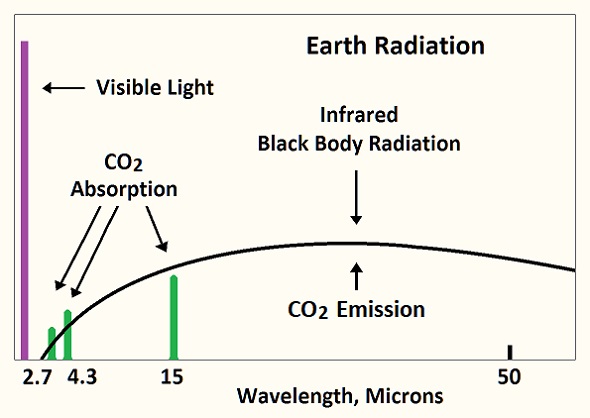
With the Stefan-Boltzmann constant being excessively high, an extremely large amount of radiation from the surface of the Earth is indicated to be available to be absorbed by carbon dioxide in the atmosphere. Reduce the radiation, and the greenhouse effect is a joke. With a corrected amount of radiation, so little radiation is available to carbon dioxide that it gets absorbed by a small amount of carbon dioxide by the time the radiation travels ten meters in the atmosphere, so more carbon dioxide cannot absorb more radiation, which is called saturation. The ten meters was measured by Heinz Hug in a laboratory as described in the global warming section. Scientists determined the limitations of saturation more than a century ago, while incompetents in physics persisted with their ignorance and motives in hyping a false greenhouse effect. Only radiation from the surface of the Earth can be absorbed by carbon dioxide in the atmosphere, because the sun's radiation is too high of a frequency. There is no significant amount of radiation given off by cold substances such as the Earth's surface. The average temperature of the surface of the Earth is only 59°F (15°C), which is too cold for significant radiation. The 2% is my estimate of a maximum possibility having worked extensively with temperature effects in electronics; but only a maximum possibility can be estimated through elimination, while the actual would be less. Radiation is so minuscule that it is ignored in most heat analysis, which means it could not be more than 2% of heat loss, while the actual would be less but cannot be estimated at such a low level. Physicists have not determined what the number should be, which is why they could produce the absurd 79%. Here's how the analysis works: The Stefan-Boltzmann constant is this:
W/m² = 5.67 x 10⁻⁸ x K4 It says, watts per square meter radiation equals a constant times degrees Kelvin to the fourth power. The average temperature of the earth's surface is said to be 15°C, which is 288°K. So 5.67 x 10-8 x 2884 = 390 watts per square meter given off by the surface of the earth on average.
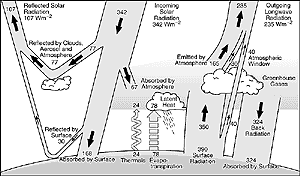
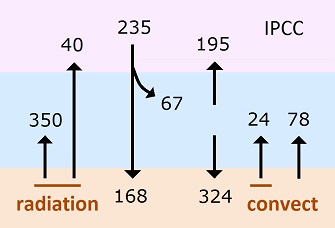
A condensed, net effect, of the Kiehl-Trenberth Model is this:
(350 + 40) ÷ (350 + 40 + 24 + 78) = 79% The radiation leaving the surface of the earth consists of two parts: 350 W/m² going from earth to atmosphere, and 40 W/m² going from earth to outer space, for a total of 390 W/m² leaving the surface of the Earth. The amount of energy leaving the surface of the Earth through conduction and convection is 24 W/m². There is 16 times as much radiation as conduction and convection. It's like a fan blowing over a rough surface and only carrying away one sixteenth as much energy as radiates away. Fans would never be used for 1/16 improvement. It's the other way around; the radiation is miniscule, which is why fans are used. These numbers are forced onto the subject by the constraints which the Stefan-Boltzmann (SBC) constant created. There has to be 390 W/m² of radiation leaving the Earth based on the SBC. The sun's energy coming in is only 235 W/m². The atmosphere is assumed to radiate a lot of energy, which must total 235 W/m² going into space. The other numbers are locked in by these constraints. The result is 79% of the energy leaving the surface of the earth as radiation [390 ÷ (390 + 102)], which is radiation divided the total leaving with conduction-convection (24) plus evaporation (78). Instead of saying there is something wrong with the SBC, physicists showed absurd amounts of radiation. The absurdly large amount of radiation is supposed to make a greenhouse effect look more real. Could anyone assume trapped radiation would be relevant if total radiation were only 2% of the energy instead of 79%? The radiation should be 2%.
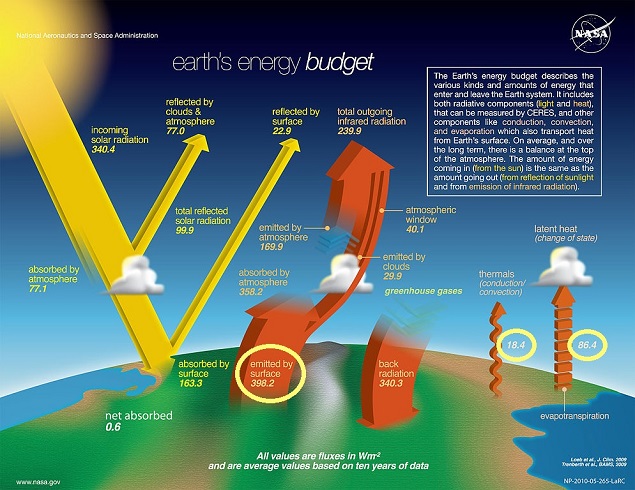
398.2 ÷ (398.2 + 18.4 + 86.4) = 79% radiation Click for larger view of NASA Energy Budget Rationalizations By Physicists What physicists say about the absurd amount of radiation shown by the Stefan-Boltzmann constant (SBC) is that absorptivity equals emissivity and you only notice the difference, which is none. Every chemical bond absorbs radiation differently, which mean absorptivity does not equal emissivity. Emissivity is the heat of vibrating nuclei creating radiation. Nuclei radiating is nothing resembling electron bonds absorbing.
For example, a small room that is 15 by 30 feet would be 159 m² of surface. At 27°C, it supposedly would be emitting 73 thousand watts of energy, according to the SBC. That's the equivalent of 41 space heaters on max at 1,800 watts each. But you notice nothing, because absorption and emission are supposedly the same. There is an awful lot of science contradicted in that absurdity. First, absorption and emission are not the same. They are vastly different, as shown by absorption spectra. The input radiation for the spectrum would be a straight line representing a constant source of radiation. The absorption curve has peaks and troughs. They are different. The reason for the difference between input and absorption is because infrared radiation is absorbed by bonding electrons which stretch and bend bond connections. Then the stretching and bending causes the nuclei to increase in its motion, which is heat production. Heat is vibration of nuclei. All heat causes molecules to radiate energy as a reduction in temperature as vibratory motion. Heat and increased bond energy can causes chemical reactions to occur, particularly for biological molecules. So some of the energy gets trapped as chemical energy (increased energy of electrons spinning around nuclei); and the amount of energy absorbed is not equal to the amount emitted. That means the room with 41 space heaters equivalent of radiation would be like a large microwave oven. The wood and biological materials would absorb a lot of radiation, just like food in a microwave oven. The inorganic material, like plaster, would absorb less radiation, like a porcelain plate in a microwave. The net result is that the different objects in the room would be at different temperatures. The wood would get very hot; and the tissues of humans would fry. But that set of conditions would not be definable, because no identifiable starting point or end point could even be theorized for a room emitting such radiation. The reason why everything is approximately the same temperature in a room is because there is almost no radiation given off at normal temperatures and only conduction and convection determine changes in temperature in a room. Electronics Shows The Results Electronics shows how much heat is produced through radiation. Every electronic component produces heat; and the dissipation is specified; so the heat can be removed. The smallest components will conduct heat into the board. At about one watt, metal is attached to the component to absorb the heat. At higher levels, the components are attached to aluminum heat sinks. Natural convection will carry away the heat from the heat sinks, if not a large quantity. With accumulated heat, a fan is needed to cool the heat sinks. So electronic engineers have temperature data for every component, which includes tables and charts for heat dissipation under various conditions. Conduction and convection are accounted for; but radiation is never mentioned, because it is almost nonexistent, even for heated electronic components.
|
 |
|
||||||||||||||||||||
 |
 |
 | ||
 | ||||
 |
 |
 |
 |
|||