
|
|
|
 |
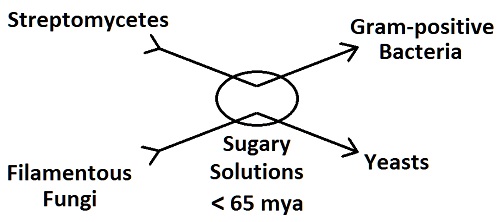
Yeasts evolved from filamentous fungi in sugary solutions about 50 million years ago as indicated by their first appearance of fossil evidence (1). Sugary solutions did not significantly exist, until flowering plants took off after the dinosaurs died out 65-66 million years ago.
One of the most striking characteristics of filamentous fungi is their ability to resist dehydration on surfaces, though a few such as the primary foot fungus gave up that ability. The surface characteristics which create that ability have not been determined, as mycologists do not significantly study physiology. Yeats gave up the ability to resist dehydration, since they grow in liquid solutions and demanding complexities drop away in evolution when not being normally required. Yeasts tend to grow well in tree exudate, but they can't normally adapt to it due to its fleeting nature and rain washing it away. But the yeast Nadsonia fulvescens adapted to tree sap by forming a spore when nutrients become unavailable.
After the transition 65-66 mya, bacteria also entered sugary solutions and competed with fungi for nutrients. So the yeast fought off the bacteria and easily won the battle, since fungi are eukaryotic and complex, while bacteria are prokaryotic and simple. However, a new form of bacteria did evolve in the sugary solutions acquiring cell walls similar to the soil bacteria, Streptomycetes. To defeat the bacteria in sugary solutions, the yeast converted the sugar to ethyl alcohol and acetic acid, which a yeast could tolerate in higher concentrations than the bacteria could. Then the remaining sugar was converted into storage fat as a method of keeping the sugar away from bacteria. Yeast commonly store up to 40% of their cell mass as storage fat. After the sugar is gone, yeasts then absorb the excreted alcohol and acid and metabolize them as energy sources. So there are two stages of metabolism for yeasts. The first stage is called glycolysis, as the sugar is broken down to two carbon compounds (ethyl alcohol and acetic acid). A small amount of energy as ATP is produced during glycolysis. The second stage is to take the two carbon compounds and break them down further through the TCA (Tricarboxylic Acid) system. A lot more energy is produced in that process. The TCA enzymes are repressed in yeast while sugar is available. Then when the sugar drops down to about 0.005%, the TCA enzymes are both de-repressed and induced by the trace of sugar. This physiology is quite apparent in the study of sporulation by N. fulvescens (2). Ethanol-grown cells would rapidly form spores in distilled water, because they had TCA enzymes available. Previous studies showed that the TCA system was need for sporulation of bakers yeast. But glucose-grown cells of N. fulvescens would not directly form spores in distilled water, since they did not have TCA enzymes. If a carbon source for energy was available, glucose-grown cells would form spores, which indicated that the TCA system could be constructed when a carbon source for energy was available. Nadsonia fulvescens had to form a spore to grow on tree exudate as a method of surviving when the exudate disappeared. But then the spore had to be formed from nutrients stored within the cells. Acetic acid prevented N. fulvescens from forming a spore indicating that it was a transcriptional repressor of spore formation. The value of that mechanism was in maximizing growth by preventing sporulation while nutrients were available in the exudate. Due to that mechanism, growing N. fulvescens on agar nutrients results in round colonies first appearing white and slowly acquiring a brown color on top, which moves downward over time. The spores produce a brown color. The acetate would be metabolized first at the top of the colony; and as nutrients were depleted, the acetate would disappear farther down on the colony allowing spores to form as the acetate is metabolized.
(1)A reference on fossil plants:
|
 |
|
||||||||||||||||||
|
 |
 |
 | ||
 | ||||
 |
 |
 |
||

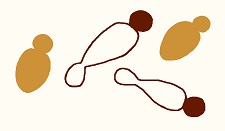 For N. fulvescens to use stored-up nutrients, the cell mass shrinks in forming the spore; so the spore forms in a smaller, adjacent chamber instead of within the cell. Being the only known yeast to form a spore outside the mother cell, it appears to be the only yeast that can form a spore in the absence of exogenous nutrients.