
|
|
|
 |
Streptomycetes would have evolved from filamentous fungi when clay was dropped onto the surface of the Earth 539 million years ago and promoted multicellular evolution with "the Cambrian Explosion Of Life." Soil life could not evolve on the shale that covered the Earth originally. But later, a thin layer of clay, about 15 inches deep covered everything. It could only have gotten there from a planet that exploded between Mars and Jupiter. Streptomycetes are a group of filamentous bacteria found in the soil. They are called gram positive bacteria, because they have the type of cell walls that would have evolved from fungi a long time ago. By contrast, the gram negative bacteria have a different type of cell walls that use a lot of lipid; and they would presumably have evolved out of stromatolites about a billion years ago; but no one knows what ancient stromatolites were. Streptomycetes evolved into more traditional forms of gram positive bacteria when dinosaurs died out and modern biology began 65 million years ago. The streptomycetes would have entered the sugary solutions of flowering plants resulting in modern, gram positive bacteria evolving in their competition with yeasts. 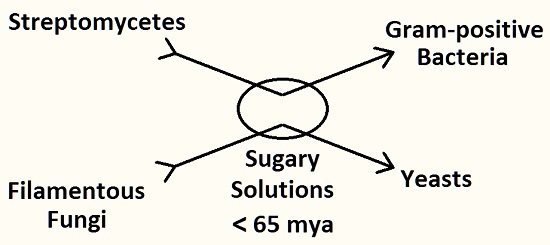 Modern Gram-positive bacteria include Bacillus subtilis and Bacillus cereus which evolved on the surface of mushrooms and plants to protect against Gram-negative bacteria which are the dread of all biology. Gram-negative bacteria evolved when there was nothing to feed on but other cells; and their lipid surfaces help break down and enter animal cells. So the Gram-negatives require a lot of nitrogen as proteins and genetic material, where Gram-positives prefer high carbohydrates, though some have adapted to attacking cells such as Staph and Strep. That means the streptomycetes are about 500 million years of evolutionary age, while modern Gram-positives are one tenth that amount at about 50 million years of evolutionary age. Out of that difference comes listeria which evolved from streptomycetes. Nothing compares to listeria for complexity and sophistication in attacking cells. It can grow in soil with the streptomycetes and then attack animals invading their cells and incapacitating the immune system. Listeria will grow on various types of food resulting food poisoning. Listeria adapts its physiology to conditions differentiating between soil and animals based on temperature differences. Nothing compares to the complex, physiological adaptability of listeria. The Cambrian Explosion Of Life P. fluorescens And Mitochondria
|
 |
|
||||||||||||||||
|
 |
 |
 | ||
 | ||||
 |
 |
 |
||

