
|
| |
 |
My research shows that the morel has an evolutionary age of about 50 thousand years. That much discrepancy shows up in extremely obvious ways. It means a large part of science has something wrong with it. The problem is power mongering in place of a study of nature. Errors are promoted as a method of insulating results from the objective reality that shows the incompetence and corruption of power mongers. The morel mushroom evolved from a single-celled yeast so recently that only a crude morphology formed, while the physiology changed very little. It shows how easily morphology can evolve and how resistant to change physiology is. Morphology is varied by counting the number of cells in different directions, while physiology is locked in place by complex relationships between all elements of the biochemistry. Physiology is the integration of biochemical processes. Physiology is dependent upon the position of enzymes and structures within cells, because reactants must move from one event to another with a minimum amount of distance. Reactants move by simple diffusion, except for the rotating proteins of ATP synthesis and the transfer proteins which move molecules across membranes. Simple diffusion would be a slow and haphazard process if distances were not short and locations precise. To change any of it would require evolution to unscramble a mess. So the morel still has the physiology of a yeast with very little physiological adaptation as a mushroom. Both physiology and morphology are extremely problematic for the morel and prevent the morel from surviving through more than one ice age cycle. Ice ages have been cycling at 100 thousand years each for about ten cycles. It might be a hot spot rotating in the center of the earth or a water clock in the Pacific Ocean that has been determining recent ice age cycles. Often, the cause is attributed to Milankovich Cycles, which means angle of rotation of the earth. But I disagree, because those cycles have so much complexity that elements overlap and mask each other, and those cycles have been going on far longer than the ten, previous, short cycles of ice ages. Melting Arctic ice is the only requirement for causing an ice age cycle to begin, because warm Arctic water would cause a lot of snow to form in the north. If the snow does not melt during the summers, it would reflect away solar energy and trigger a precipitous cool-down. When the ice sheet gets fully formed, it would be a dehumidifier for the planet drawing moisture out of the air. The rest of the planet would get hot and dry, particularly since the ocean level drops about 400 feet. The face of the ice sheet would be almost a vertical cliff due to the extreme differences in temperature. At the face of that ice cliff, humans found ideal conditions for creating cultivated crops, and the morel mushroom found suitable conditions for evolving from a single-celled yeast. The ice cliff was about a mile high. Cold, foggy air would sweep down the face of the ice sheet, and small streams of water would follow the contours of the ground. Within a mile or two would be hot, dry air. The morel required such conditions to evolve from a yeast, because yeasts do not tolerate dehydration. The yeast that I studied in graduate school, (Nadsonia fulvescens) evolved in the area of St. Petersburg, Russia, and is found no where else, because the Baltic air was cold and humid enough to prevent the yeast from drying while evolving on tree bark. A similar yeast, probably Schizosaccharomyces japonicus, grew on the bark of a tree near the face of the ice cliff, where the humid air allowed surface growth without dehydrating. This yeast is filamentous, which allowed it to grow down into the soil to feed on bacteria while maintaining surface growth for disseminating spores. Yeasts normally can feed on bacteria by excreting acetic acid and ethyl alcohol, which kill the bacteria causing them to autolyze (split apart) and release nutrients. But usually, bacteria are kept out of the yeast environment so effectively that they do not provide much for yeast nutrients. If however, yeast filaments can extend into the ground, feeding on bacteria would automatically occur.
The morel cannot survive through more than one ice age cycle, because all of its characteristics, both morphological and physiological, are poorly suited for any type of growth. The morel will only grow in damp sand or something similar, because it will not tolerate dehydration as other mushrooms must. Sand does not dry out below the surface, because it lacks capillary action for moving water upward.
The dependence of the morel on sclerotia means its spores do not have to resist adverse conditions. They are used for dissemination only, and they germinate readily in water for this reason. Morel spores are very poor at dissemination, being embedded in tissue (ascospores). They can only be expelled upon drying of the tissue, which creates a propelling force. Air flow is quite ineffective at dissemination of morels. So morels spread slowly along sandy river basins, which does not require much air-borne dissemination.
To survive through an ice age cycle requires the morel line to evolve into a cup shape. The morel itself does not succeed at doing so, but apparently Helvella crispa does. H. crispa is shaped like a potato chip on a stalk. To form a cup shape, all it has to do is curl upward and shorten the stalk. The cup shape is required for adversity because of the requirement for the tissue to dry in propelling the spores out. If the tissue dries too soon, the spores do not adequately form. If drying is too slow, the tissue breaks down without propelling spores out. To get some spores out every year requires the cup shape, so some tissue dries slowly near the bottom, while some dries rapidly near the rim. Someplace in between will always dry at the right time to get spores out for survival through the winter. Sclerotia cannot be used for that purpose, since it can only be produced when there is an abundance of bacteria in early spring soil to splurge on.
There are some molds which have small cup shapes, because they have acquired the ability to tolerate dehydration, which is extremely demanding physiology; and they found special niches during earlier evolution which was less demanding.
Another example of the inadequacy of morel physiology is that it still produces residual autolysis. All bacteria and yeast use autolysis (self-splitting) as a method of recycling nutrients upon various signals such as drying. They break down proteins into amino acids and nucleic acids into nucleosides (spitting off the phosphate). In the soil, bacteria feed these molecules to plants in a symbiotic manner. The plants excrete small amounts of TCA acids to feed the bacteria, and if they need more nitrogen, the plants presumably increase the acid, which causes the bacteria to autolyze and feed the plants nitrogen containing molecules. Humans do not use genetic material as a nutrient, because breaking it down is too difficult, and it would be in the wrong location. It normally forms near the nucleus of cells. Diffusing through cells would be like carrying lumber through a church. The phosphate must be split off for recycling nucleic acids as nutrients, which is very high in energy and requires a three enzyme system for bacteria. So genetic material which humans eat ends up in the large intestine, where E. coli breaks it down and creates CO2 gas. It's the cause of gassiness with beans. Scientists have never figured it out, so the try to design beans which are not gassy. Filamentous fungi including most mushrooms never autolyze, because they need long-term survival. The morel gains nothing from residual autolysis, but it has not had enough time to evolve it away. It can be observed on older morels, as one side rots away. Bacteria grow on the autolyzing tissue, which can cause persons to get sick in eating old and deteriorating morels. Autolysis is also observed under laboratory conditions as a brown color and excretion of alkali with aging of morel mycelium. Morel mycelium excretes acid to kill bacteria in the soil and feed on them. The mycelium spreads over a large circle, typically five feet or more in diameter, which requires more than one year. The acid accumulates near the mycelium and kills nearby bacteria. When the mycelium is grown under laboratory conditions, the acid accumulates and kills the mycelium. Morel mycelium must be restarted often in the laboratory, as acid accumulation kills it off. The accumulation of acid will make morels difficult to grow under artificial conditions. So morel evolution would have begun about 50 thousand years ago, as a yeast extended filaments into the soil to exploit bacteria. It would have become a free-forming mushroom emerging from the soil about 20 thousand years ago. It shows some regional variations including a black color which is promoted by leaves on the ground. It shows unlimited phenotypic variation with no significant probability of two phenotypes being exactly the same.
Other species form very few phenotypes, and they have highly refined properties. The main line of the puffball shows four phenotypes which come up in sequence from the same mycelial mass.
The Original Science Paper: www.sciencedirect.com/science/ 2. Thomas N. Taylor and Edith L. Taylor. The Biology and Evolution of Fossil Plants. 1993. Prentice Hall, Englewood Cliffs, New Jersey.
|
 |
||||||||||||||||
 |
 | ||
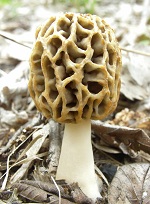 Morel mushroom scientists at the universities claim the morel is an ancient cup fungus with an evolutionary age of 129 million years. (1) That would mean only the puffball and bolete are older mushrooms taking form about 300 million years ago. The molds did a lot of diversifying between 300 and 200 million years ago. (2) The gilled mushrooms took form with modern biology after dinosaurs died out 65 million years ago.
 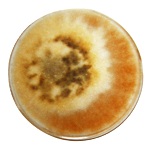 The yeast grew at the base of trees where the humidity was protective of dehydration while feeding on bacteria in the soil. The morel still wants to revert to that type of growth when growing on a surface in the laboratory. I show numerous anomalies of that type of surface growth on agar plates. It shows that physiological patterns get stored in DNA and can be re-activated later.
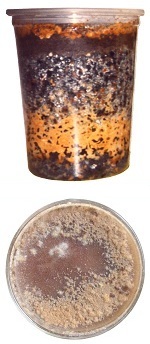 The morel is adapted for growing in wet spring soil, where bacteria are extremely high in numbers. Since there is an excess of nutrients for awhile, the morel invests in underground storage cells called sclerotia. Sclerotia cells act like spores carrying the organism through summer heat and winter cold. Each time rain occurs during the summer, sclerotia cells start to grow again; and as drying occurs, sclerotia forms again.
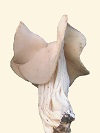 There is another species that evolved with the morel, called Helvella crispa. It comes up later, when the burst of bacterial growth in the spring has died down. It does not appear to form sclerotia; its spores must resist adverse conditions; and they do not germinate readily.
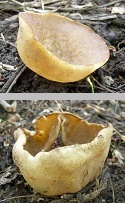 The cup shape apparently survives through two ice age cycles, as there are two cup fungi related to the morel—Disciotis and Discina, which have identifying spore surfaces similar to the morel. They cannot survive more than two ice age cycles, because even the cup shape is disastrously inadequate for long-term survival due to the inadequacies of ascospores for the purpose.
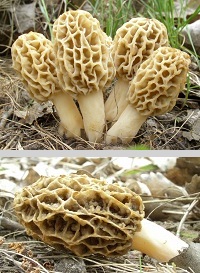 The morel evolved so recently that it does not measure gravity to determine vertical growth. Everything that emerges from the soil measures gravity for vertical grown, but not the morel. The morel simply grows in the same direction that it starts growing, which usually creates some verticalness by starting with a flat pad near the surface. When the direction of the pad changes, the direction of morel growth changes.
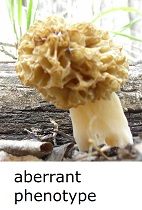 The morel does not vary phenotypes in a controlled way. It randomly re-scrambles a combination of characteristics each time a spore is formed. As a result, most of the phenotypes growing under extreme conditions are nonfunctional and do not produce spores. This results in some of the morels being very weird looking.