

|
|
|
 |
Evolution changes in its characteristics over time, as differentiation becomes more complex and mainline species become more sophisticated. All complex biology will become extinct in about 2-10 million years due to extreme differentiation. Differentiation constantly increases in complexity. As it does, contradictions develop due to dependencies which would be nullified by changes. So evolution patches up the contradictions, while they increase. Two mushrooms show extreme evolution: the puffball and bolete. They evolved as conifers evolved, 300 million years ago. That's when low hills began to form, as tectonic plates collided. The lowlands were covered with nonwoody brush inhibiting evolution of plants and animals. The hills allowed new species to evolve, as water washed off the sides of the hills and changed the ecology. Along with the conifers evolving, space was available for a small number of flowering plants and those two mushrooms.
There are windows for evolution which close as ecology changes. The earliest evolution allowed the most freedom and flexibility due to fewer competitors than now days. So micro-structures and physiology could do things that are no longer possible. Also, differentiation keeps increasing over time, which results in contradictions that don't get entirely resolved. The conflicts reduce alternatives and prevent drastic revisions. The modifications get simpler over time. The stunning characteristics of the puffball are numerous. The main line reduced its phenotypes to four, which come up in sequence of a few weeks apart. The mycelium apparently sectors to form the phenotypes.
The macro structures emerge about once every ten years, while the mycelium spreads continuously underground. The reduced emergence protects against insects and disease evolving against it. The spores use a mechanism that prevents them from germinating until carried high into the atmosphere, as Agaricus also does. Then the growth is not only widely scattered but also resistant to disease and insects evolving against it. Boletus edulis
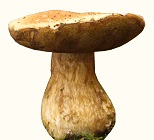
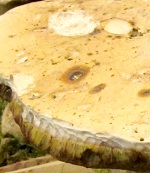
B.e. acquired a symbiotic relationship to conifer roots which it depends upon for nutrition. It does not depend upon wind for significant spore dissemination. Instead, animals eat the tissue and carry spores around. One of the astounding characteristics of B.e. is that it removes all flavor from the tissue while increasing in size. Bite marks on the cap show that animals walked away after taking one bite. Mushrooms now days cannot remove all flavor from the cap, because such evolution is quite demanding and that much change in physiology is not possible. So modern mushrooms use toxin when they need to inhibit eating by animals. B.e. has much more flavor than other mushrooms, except for truffles, since it has developed flavor for attracting animals. Other mushrooms have accidental flavor related to fungal mycelium. But when the developed flavor of B.e. occurs in the wild, insect larva overtake the boletes. So younger boletes are picked before they have much flavor. If they are dried slowly, they develop some of their flavor while drying. Evolution Of Molds Fossil evidence shows that molds evolved their complex micro-structures between 300 and 200 million years ago. That type of evolution is no longer possible, because micro-structure evolution is too demanding for now days. It's too slow; and competitors would overwhelm the organisms while diverted for such evolution. Back then evolution was quite frivolous as shown by clamp connections of molds. When cross-walls evolved, a tube would grow externally around the cross-wall, which is called a clamp connection. Then various things would happen in that tube. Clamp connections still exist, even though they are too crude for modern purposes. That's because evolution does not allow structures or functions to disappear without an advantage in doing so. A leaf mold is said to be a conidial stage of the morel mushroom. Theoretically, such micro-structures as conidia would not have evolved over the past 200 million years. Gilled mushrooms would have acquired their basidia from ancestors. The morel is said to be 129 million years old for evolutionary age; but it began its evolution 50 thousand years ago in front of the ice sheet and emerged from the ground about 20 thousand years ago. Reference On Fossil Plants:
|
 |
|
||||||||||||||||
|
 |
 |
 | ||
 | ||||
 |
 |
 |
||

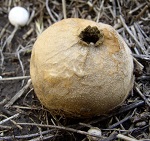 The puffball has better spore production than other mushrooms, as the entire insides are converted into spores. So why don't more recent mushrooms use that design? The reason is because micro-structures and physiology would require drastic evolution which could not occur later.